Difficult Conversations: Leading Through Conflict
Scenario-Based eLearning | Leadership Development | Interactive Learning Experience
Audience: New and emerging people managers
Format: Self-paced, browser-based learning experience
Target Duration: 7–10 minutes
Role: Instructional strategy, scenario design, development, and quality assurance
Overview
Difficult conversations rarely begin with complete information. Managers must listen to concerns, evaluate competing explanations, and establish accountability without making premature judgments.
Difficult Conversations: Leading Through Conflict is an interactive learning experience designed to help new managers practice those skills in a realistic workplace scenario.
Rather than presenting a series of best practices followed by a knowledge check, the experience places learners directly into the manager's role. Their decisions shape the conversations, determine what information becomes available, and influence the eventual outcome.
This independent portfolio project demonstrates how scenario-based learning can support leadership development through authentic decisions, meaningful consequences, and personalized reflection.
The Challenge
New managers often face situations where interpersonal tension, performance concerns, and unclear processes overlap.
An employee's frustration may be entirely legitimate, even when their interpretation of another person's actions is incomplete. Addressing the concern effectively requires more than empathy or accountability alone.
The instructional challenge was to design a brief, engaging experience that would allow learners to practice three essential behaviors:
Acknowledge employee concerns without accepting unverified conclusions.
Investigate competing explanations and distinguish process problems from individual responsibilities.
Establish appropriate expectations, corrective actions, and follow-up.
A traditional multiple-choice knowledge check could assess whether learners recognized these principles. I wanted to create an experience that let them explore what happens when those principles are applied, overlooked, or recovered during an actual conversation.
The Approach
Learning through decisions
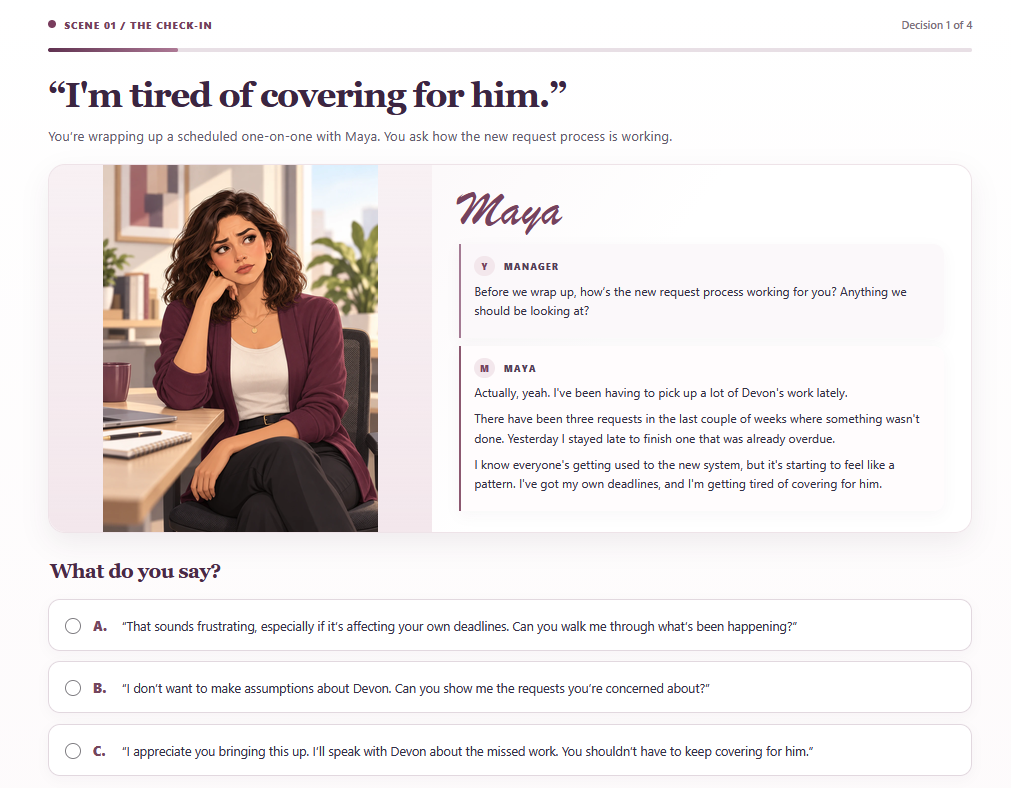
The scenario begins during a scheduled one-on-one meeting. An employee raises concerns about repeatedly covering a colleague's unfinished work.
The learner must decide how to respond.
As the situation develops, additional information becomes available through conversations and workplace records. The learner encounters competing perspectives and must determine how to proceed without having a complete picture from the outset.
Four primary decision points guide the experience, with additional opportunities to investigate unresolved concerns or repair a conversation that has become defensive.
Progressive information
A central design decision was to make information dependent on the learner's actions.
Conversation notes capture what the learner has encountered, while supporting records become available only when introduced during the scenario. Information that has not been discovered remains unavailable until the final debrief.
This creates a distinction between what a manager knows, what an employee believes, and what still needs to be verified.
Consequences without simple right-or-wrong labels
The scenario avoids overtly identifying preferred responses while decisions are being made.
Instead, employee reactions, additional dialogue, and subsequent events provide feedback about the effects of the learner's choices.
Imperfect responses do not automatically end the learning experience. Learners may have an opportunity to recover, ask additional questions, and improve their approach.
Personalized reflection
The experience includes four potential narrative outcomes, followed by a review of the learner's actual decisions.
The debrief connects what the learner said or chose with the characters' responses and the resulting impact.
Only after this reflection does the experience reveal the complete situation, allowing learners to compare their understanding with the underlying facts.
A printable Hear → Verify → Act guide reinforces the central skills and provides a practical resource for future management conversations.
Deliverables
The completed project includes:
A responsive, illustrated eLearning experience with branching dialogue and four primary decisions.
Conditional conversation paths, including investigation and recovery opportunities.
Progressive conversation notes and supporting workplace records.
Four narrative outcomes and personalized decision reviews.
A complete case reveal connecting employee perspectives with management responsibilities.
A printable one-page conversation guide.
Technical and instructional design documentation, including a quality assurance report.
Results & Evaluation
The completed module is publicly accessible as a standalone learning experience.
Technical quality assurance evaluated all 135 authored decision combinations, confirming that each route generates a valid outcome and the appropriate personalized feedback.
Additional testing covered decision navigation, randomized response order, backtracking, keyboard interactions, and responsive layouts at six viewport widths.
The QA process also identified and corrected accessibility-related interaction issues, including unintended form submission and keyboard focus behavior.
These findings demonstrate the functional completeness of the experience. They are not presented as evidence of improved workplace performance.
The next evaluation step is a small learner pilot focused on clarity, authenticity, usability, and whether participants can transfer the scenario's central principles into their own management practice.
Role & Tools
I directed the project from instructional concept through development and quality review, including:
Defining performance objectives and the instructional strategy.
Developing the workplace scenario, dialogue, decision points, and consequences.
Designing the progressive-information and personalized-feedback systems.
Establishing the visual design and overseeing illustration development.
Building and refining the interactive experience using HTML, CSS, and JavaScript with AI-assisted development support.
Conducting iterative testing and correcting issues identified during QA.
Publishing the module using GitHub Pages.
The experience was intentionally developed without an LMS requirement or proprietary authoring-player dependency, making it accessible directly from a standard web browser.
Design Reflection
The most important design choice was resisting the temptation to tell learners what to do before giving them an opportunity to decide.
Effective management often means working through uncertainty rather than selecting an obviously correct answer. By making information, reactions, and consequences depend on the learner's decisions, the experience creates an opportunity to practice professional judgment.
The result is a compact leadership-development activity built around a simple principle:
Hear the concern. Verify the causes. Act with clarity and accountability.